This comes up often enough that I’m putting it in one place to point people to.
The short version
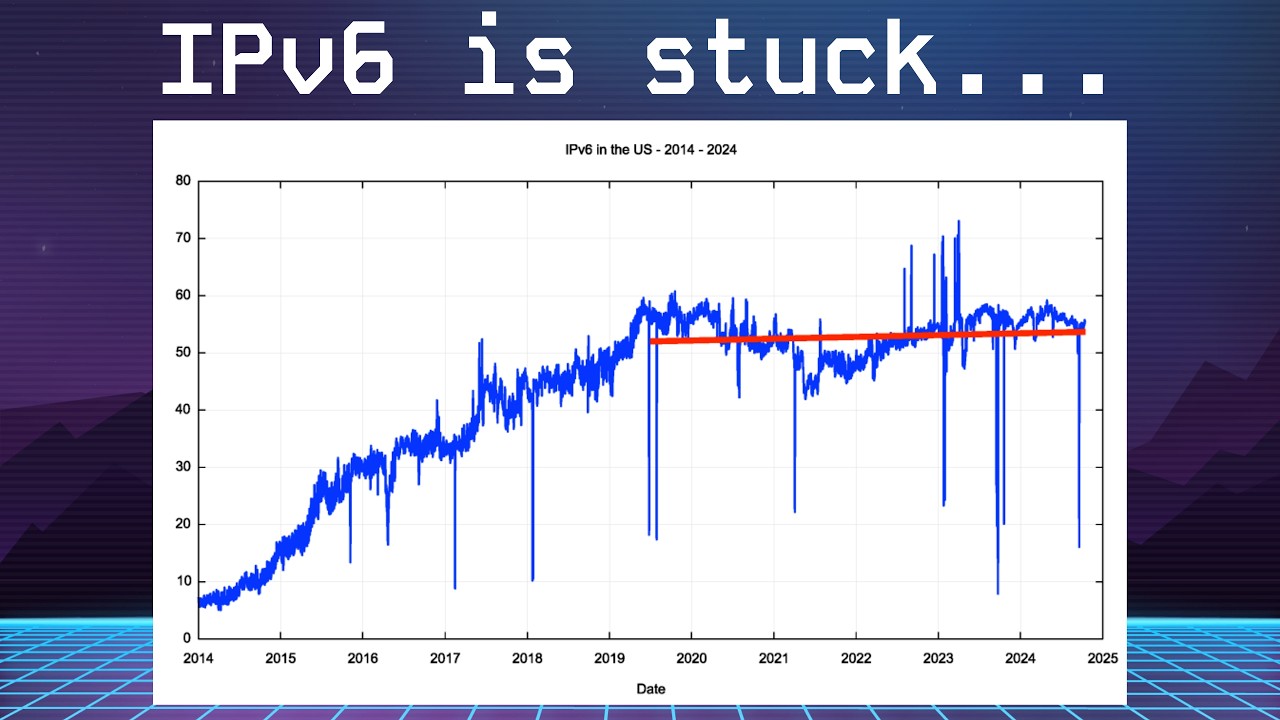
IPv6 hasn’t replaced IPv4 because it never gave the people who’d have to deploy it a reason they couldn’t ignore. The whole point of IPv6 was to solve IPv4 address exhaustion. But the industry already solved exhaustion well enough with NAT and a few server-side tricks, so the urgency that was supposed to force the switch just never materialized.
The core argument
Geoff Huston, Chief Scientist at APNIC and probably the most-cited researcher on IPv4 exhaustion, lays this out well in his 2024 piece The IPv6 transition. His central point: IPv6 is essentially “IPv4 with bigger addresses.” It isn’t faster, it isn’t more versatile, and it isn’t more secure. Its one real benefit is relief from address exhaustion, and that’s a future risk the market heavily discounts.
The pressure got absorbed from both ends of a connection, and it’s worth seeing both, because people tend to only think about one.
On the client side, NAT made IPv4 stretch far past its expected life. Huston notes the Internet is now sharing each IPv4 address across an average of about seven devices, and it all just works. Every home with a router is doing this already. Carriers took the same idea further with Carrier-Grade NAT (CGNAT), sharing a single public IPv4 address across many subscribers, which let mobile and broadband providers keep onboarding customers long after the free address pool dried up.
The Serial Port YouTube Channel has great video covering the history of the PIX and being first widely successful product to include NAT.

On the server side, the rescue came from TLS Server Name Indication (SNI). Before SNI, hosting multiple HTTPS sites generally meant one IP per site, because the server had to pick a certificate before it knew which site the client wanted. SNI fixed that by having the client announce the hostname it’s after during the TLS handshake, so a single IP can front a large number of separate sites and the server picks the right cert and service by name. That quietly killed one of the biggest remaining reasons a host needed lots of public IPs. As an example, GRC runs more than a dozen web services off a single IP this way, with DNS pointing all those names at the one address.
So between NAT and CGNAT soaking up client-side demand and SNI soaking up server-side demand, the address crunch that was supposed to force everyone onto IPv6 got managed instead. That’s the whole reason the urgency evaporated.
The result is what I’d call adoption by attrition. Huston’s data shows that more than a decade after IPv4 ran out, only about a third of users could reach an IPv6-only service as of 2024, and at the trend rate the transition wouldn’t finish until somewhere around 2045.
The objections worth knowing about
This isn’t a settled debate, and if you cite Huston, expect pushback. The fair counterpoints:
NAT is breaking down at scale. The Internet Society points out that large ISPs running Carrier-Grade NAT are finding even the biggest private IPv4 block of 16.7 million addresses isn’t enough, so they’re stacking multiple layers of CGN, which creates real performance and management problems. They also note NAT forces routers to rewrite packets, which adds a performance hit and breaks protocols that embed IP literals instead of domain names. See the Internet Society IPv6 FAQ. So “works well enough” is getting shakier for the carriers actually carrying the load.
Eliminating NAT is itself a benefit. ARIN frames IPv6 as more than address count: no NAT, a globally unique address per device, stateless address autoconfiguration (SLAAC), and simplified headers that cut administrative overhead. See ARIN’s writeup. Restoring true end-to-end connectivity matters for peer-to-peer, VoIP, gaming, and IoT, all of which NAT complicates.
The “stalled” numbers are higher than they sound. Per Google’s data reported by Network World, global IPv6 adoption was around 43% as of December 2024, with the U.S. near 49%, and mobile and carrier networks leading the way. DigiCert’s 2025 overview agrees with the diagnosis (no urgency while IPv4 still works) but argues dual-stack is a poor long-term answer and that government mandates are slowly raising the pressure.
One caveat on sourcing: ARIN is a regional registry and DigiCert sells managed DNS, so both have a stake in promoting the transition, the same way you could argue Huston writes from an RIR’s vantage point too. Weigh accordingly.
Bottom line
The disagreement is mostly about framing, not facts. Everyone agrees NAT is the reason IPv4 is still standing and that adoption has been slow. The split is whether that’s a stable equilibrium (Huston’s “works well enough”) or a problem we’ve deferred whose costs are quietly piling up at the carrier level. IPv4 isn’t dying on a schedule. It’s dying by attrition, if it dies at all.
Sources
- Geoff Huston / APNIC, The IPv6 transition (2024): https://blog.apnic.net/2024/10/22/the-ipv6-transition/
- Internet Society, IPv6 adoption and IPv4 exhaustion FAQ: https://www.internetsociety.org/deploy360/ipv6/faq/
- ARIN, What Is More Energy-Efficient: IPv4 or IPv6?: What Is More Energy-Efficient: IPv4 or IPv6? - American Registry for Internet Numbers
- Network World, What is IPv6, and why aren’t we there yet?: What is IPv6, why is it so important, and why is adoption taking so long? | Network World
- DigiCert, The State of IPv6 Adoption in 2025: The State of IPv6 Adoption in 2025: Progress, Pitfalls, and Pathways Forward
If you want the long version, Steve Gibson covered Huston’s article in detail on Security Now #998, “The Endless Journey to IPv6” (Oct 29, 2024). Show notes: https://www.grc.com/sn/SN-998-Notes.pdf